
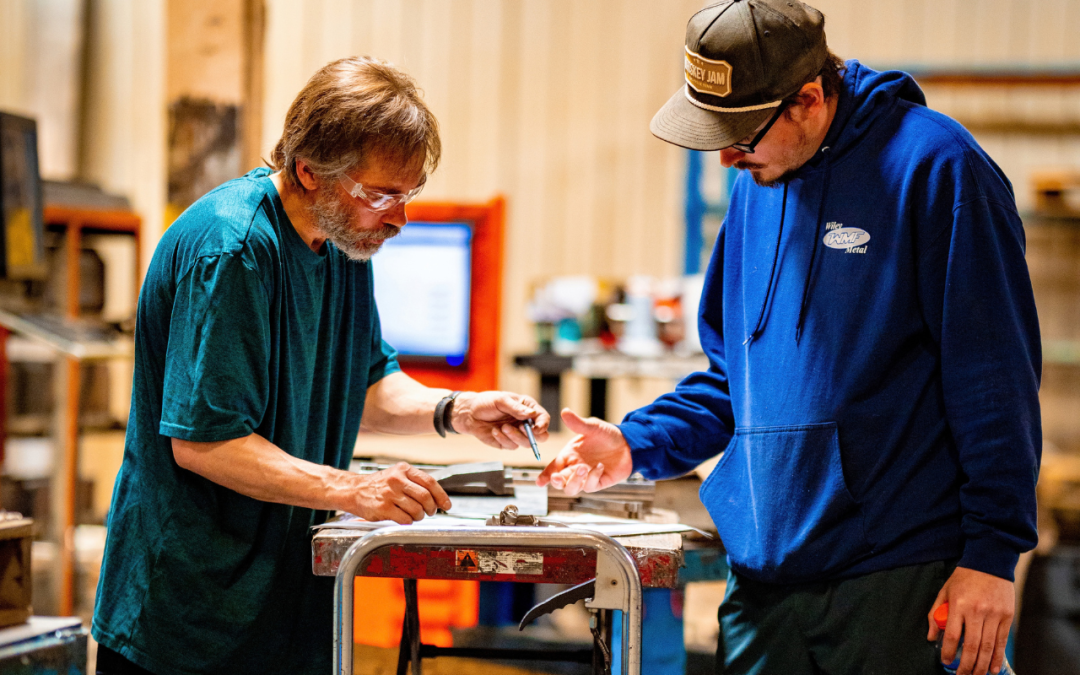
A finished drawing shows up. A quote goes back. For a lot of parts, that’s the whole conversation, and there’s nothing wrong with it.
But by the time a drawing reaches us, a good share of what that part will cost is already settled. The tolerances, the welds, the processes it’s going to need. All of that got decided upstream, and all of it turns up in the price whether or not it ever came up in conversation.
Our Engineering Department can turn your part or product ideas into detailed drawings, and should we see a better way of doing something, or of improving the performance of your metal fabrications, we’ll talk to you about it. That’s a conversation worth having before a part gets quoted rather than after it’s ordered.
Where Fabrication Costs Get Decided
Tolerances, welds, and process choices all show up in what a part costs to build. All three are decided on the drawing, usually before anyone thinks much about cost.
Take tolerances. Tighter ones are in general harder, and therefore more expensive, to achieve. What we apply is the precision needed for the cut parts to go together, for the product to function correctly, and to make sure the appearance is satisfactory. Sorting out which dimensions really need that precision is most of the job.
Take process. Aluminum and steel behave differently during cutting, forming, and welding, and those differences affect production flow, repeatability, lead times, and overall efficiency. A design can look perfectly reasonable on a screen and still turn into a puzzle once it reaches the floor.
Design for manufacturability is the term for it. In metal fabrication, it mostly means catching these things while the drawing can still change.
What a Print Does Not Always Say
Customer prints seldom have all the information needed to make excellent weldments and fabrications.
That’s no knock on the engineers who send them. A design print answers design questions: what the part is, what it has to do, how it fits the bigger assembly. It was never meant to say which weld goes where, what size it ought to be, or which dimensions truly have to be held.
So we make our own prints, spelling out key features like weld call-outs and critical dimensions. Getting that done while the design is still open means those questions get answered with you, sitting down, instead of by whoever’s setting up the machine at six in the morning. Most of us have been on the wrong end of that one at some point.
The Kinds of Changes That Come Out of a Drawing Review
Four things, mostly.
Weld call-outs. Where the original drawing leaves them open, we fill them in.
Critical dimensions. Which ones have to be held tightly, and which have a little room.
Tolerances. Set to what the part actually needs.
Manufacturability. Whether small adjustments can improve consistency and reduce long-term production costs without changing how the part functions.
We’ll look at whether an assembly can be simplified too, or the fit and function improved.
None of it is dramatic. These are changes that cost nothing on a drawing and a fair bit once there’s tooling sitting in the corner.
What Early Collaboration Actually Involves
The drawing review is one step in a sequence, and it comes at the front end of a working relationship.
We start by addressing the challenge. We get to know the executive team as people. We come out and see the place, usually across several visits, because there’s only so much you can learn over the phone. We collaborate on improvements and efficiencies. Somewhere in there sits an engineering drawing review and a complete cost-saving and efficiency review.
It works best with manufacturers running high production runs who genuinely want engineering help. Folks who are growing and who don’t mind poking around for efficiencies alongside us.
Designing Alongside Wiley Metal
What we’re after is a trusted, valued partnership where Wiley Metal helps fuel efficiency and innovation efforts. The drawing review is where that gets started, not the whole of it. The rest of the sequence runs from that first site visit through ongoing production.
We fabricate for semi-truck trailers, recreational vehicles, utility trucks, and material handling, and the engineering conversation looks about the same across all of them. Cutting, forming, welding, finishing, assembly. It all happens at our shops here in Marion, Indiana, and our quality management system is ISO 9001:2015 certified.
Where the Conversation Usually Starts
Design decisions shape a part’s cost long before anyone cuts material. A review early on is cheaper than a change later, and it’s a shorter conversation.
If you’re growing and you’d rather have a fabricator in the room at the engineering stage than only at the quote stage, reach out.