
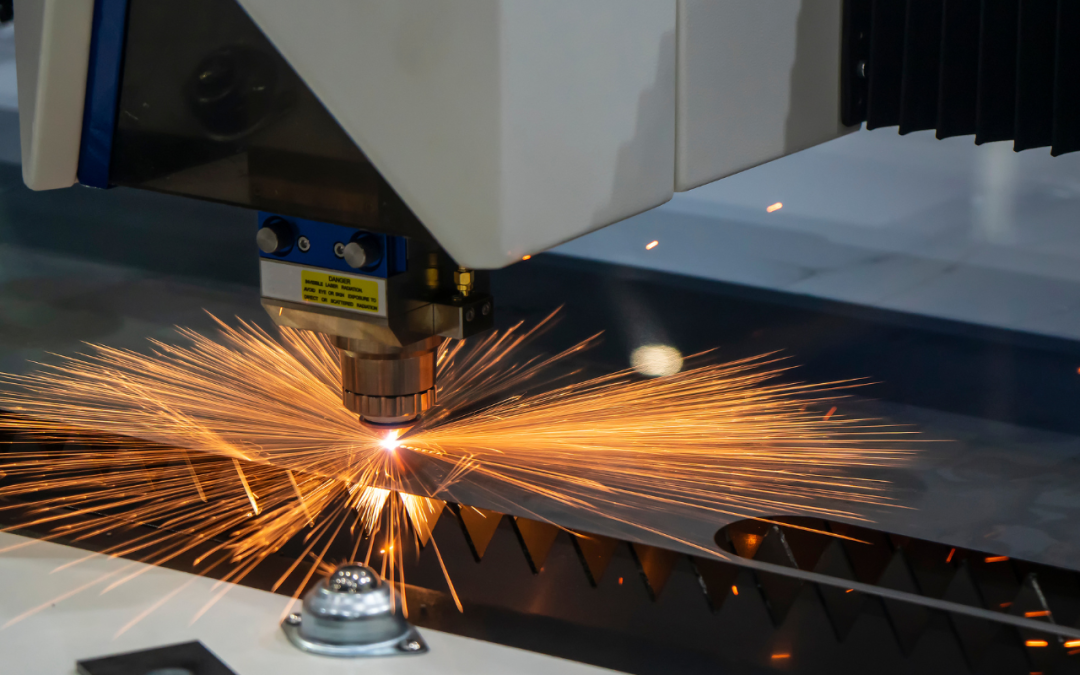
Every laser spec sheet leads with speed. Inches per minute, at such-and-such thickness, in such-and-such material. It’s the number everybody quotes, and it’s a real number.
It’s also not the one that decides whether your parts show up when you need them.
A shop with one very fast laser and a full queue will quote you a longer lead time than a shop with two slower ones and a little elbow room. Capacity is the question sitting underneath every delivery date, and it’s a harder thing to get at over email.
Capacity and Speed Are Different Questions
Speed describes a machine. Capacity describes a shop. The two get mixed up easily, and they’re worth keeping straight.
Cut speed tells you how fast one laser gets through one material at one thickness. Handy for figuring cut time on a single part.
Capacity tells you how much work a shop can have going at once, and how much of that is already spoken for. That’s what decides when your job starts, which for most orders matters a good deal more than how long the cutting takes.
Truth is, on a typical sheet metal part, the actual cutting is a small slice of the time between order and shipment. The rest is queue, setup, forming, welding, finishing, and hauling things from one spot to the next.
What Independent Laser Cells Change
A laser cell is the cutter plus the automation around it: the material handling that feeds sheet in and pulls cut parts out. When a cell is autonomous, it runs that cycle itself, so it keeps going without somebody standing there feeding it.
Running more than one independent cell changes what happens when something goes sideways. And something goes sideways eventually.
One machine means one queue. Maintenance, a fixture change, or a long job on thick plate, and everything behind it waits. Two independent cells mean the work can move. A job that would’ve sat runs on the other cell instead.
It also changes what can run at the same time. Different materials, different thicknesses, different job sizes don’t all have to funnel through one bottleneck.
At Wiley Metal, we run two independent and autonomous laser cells, which gives us a lot of flexibility, and our laser cutting covers both fiber and CO2. We recently invested in an additional 10kW fiber laser, and that one cuts thicker material faster than ever.
How Scheduling Turns Capacity Into a Delivery Date
Capacity on the floor only turns into a delivery date if somebody’s managing it.
Two things do that work. First is level loading, which means spreading jobs evenly across the weeks instead of letting them stack up behind whichever job landed last. We level load our shop floor schedules and manage schedules and sales by the number of hours in each work center. So the question isn’t how many jobs are open. It’s how many laser hours exist, and how many are already claimed.
Second is leaving room on purpose. We manage to an 85% capacity target specifically to allow for drop-ins and hot orders. A shop booked to 100% has no room by definition, and the only way it can say yes to a rush is to move somebody else’s date. (Somewhat frugal Midwesterners don’t much care for leaving capacity on the table. We do it anyway, because the alternative costs more.)
Our shop floor runs live schedules, which lets the data set priorities, and we track key metrics in a daily ops report. Our operating commitment is sustained on-time delivery above 90% for all customers.
Questions Worth Asking on a Plant Visit
Capacity is hard to read off a website. That’s part of why plant visits are worth the trip. You’ll pick up more in twenty minutes on a shop floor than you will reading about it. A few questions get at it quickly.
How many laser cells do you have, and are they independent? Two machines sharing one material handling system aren’t the same as two that run separately.
How much of your laser capacity is committed right now? A shop that manages to a deliberate buffer will know that number off the top of its head.
Do you schedule the laser by job, or by work-center hours? Hours-based scheduling is what makes the previous question answerable.
What happens to my job if a cell goes down for a day? The answer tells you how much the redundancy is really worth.
What’s your on-time delivery rate across all customers, not just the biggest ones? A rate that only holds for the largest accounts won’t tell you much about your own orders.
None of these need a plant tour to ask. All of them are easier to believe with one.
How Wiley Metal Runs Its Laser Cutting
Our laser cutting runs across two independent and autonomous laser cells, covering fiber and CO2, on material from 1/64″ up to 1″ thick. Narrow kerf and minimal heat zones, paired with dynamic nesting, are what keep material efficiency up.
Laser is one piece of a wider range of cutting and processing capability. We also run CNC turret punching, precision plasma cutting with punch capability, CNC shearing, and a five-axis waterjet. Whether a part is better cut on a laser or a waterjet comes down to the material, the thickness, and the edge it needs. Each part goes to the process that suits it.
On the scheduling side, level-loaded schedules, work-center-hour management, and that 85% target are what turn the equipment into a date we can actually hold.
Ask About Capacity Before You Ask About Speed
Machine speed tells you what a laser can do on a good day. Capacity and scheduling tell you whether a fabricator can hold your date on an ordinary one.
If you’re weighing up fabricators and want to see how your volumes would sit inside our schedule, contact us. We’d be happy to talk.